

Cappings
Pierce County Beekeeping Association
Monthly Newsletter
Sept/Oct 2026 - Volume 32 - Issue 6
Dear Fellow Beekeepers,
As summer winds down and we settle into the rhythm of fall, I wanted to take a moment to thank everyone for the time, energy, and heart you poured into our club this season — especially at the Fair.
A few people deserve special recognition:
Katie Marler — for her tireless work in managing our apiary and teaching classes that helped so many of us grow as beekeepers this year. Under her watch we are heading into winter with 20 hives. No small task!
Michelle Cyree — for her outstanding work in organizing our whole approach to the Fair this year and bringing a real revamp of energy and support materials that made everything run smoother. Michelle was also able to print us some formal PCBA Name tags, we are very grateful and excited to roll them out.
Bryce Landrud - Under Bryce's due diligence and connections we have obtained and installed a 20ft Conex Box and installed it at the WSU Barn by the production Apiary. This is a game-changer for the club. We finally have a safe and accessible storage area for our belongings!
Cathy Barron - Big congratulations to Cathy for taking on the role of Events Chair for the club! So needed. She has an eye for detail and a great ideas to improve our impact in the communities. Looking forward to what is to come.
Chris Camper — for his dedicated leadership managing our swarm team all season. Chris had a great attitude this year while fielding hundreds of swarm calls. His work earned us the main contact role for Fort Lewis McChord and NW Trek. Thanks to all of those swerving on the swarm list as well! Great job interacting with the community in such a positive manner.
Jason Faber — for his diligence in helping community members deal with wasps and bumblebees in a kind and understanding manner. He offered relief that isn't easily found through conventional businesses by relocating bumbles and donating venom gathered from wasp and hornet nests to antivenom centers. Supporting efforts in keeping those with allergies safer, and in some cases, alive - when they are stung.
Kelly Daly & Kristin Collett -- Massive thanks for their work on the Picnic this July. They did a wonderful job! Delicious!
We had a wonderful Picnic in July, and August (spilling right into September) has been a full one for all of us. It's amazing how quickly beekeeping shifts gears from summer to fall — most of us are wrapping up honey processing, moving to 2:1 feeding, installing robbing screens, building quilt boxes, and starting fall varroa mite treatments.
And just like our bees, we're shifting too — turning our attention toward family, gratitude, and the holidays ahead.
Here's what's coming up:
-
October 5th: Presentation on Slovenian Hives, presented by Debra Langley Boyer
-
November 2nd: Presentation on Hornet Extraction and BumbleBee relocation by Jason Faber
-
December 7th: Our holiday party and White Elephant exchange
Thank you all again for making this such a rewarding season. Looking forward to seeing everyone as we move into these next gatherings.
🐝 Washington State Fair — Volunteers Needed! 🐝
The last 2 weeks of the fair are coming and we are lean on those at the booth. This is both a tremendous opportunity to educate the public about bees and to earn your volunteer hours toward the club.
Even the most novice beekeeper knows an enormous amount more than the general public about bees — and that knowledge is genuinely valuable at the booth. Whether you've been keeping bees for one season or twenty, your presence makes a difference!
The dates are Sept 4-27th (Closed Tues & Sept 9). You can sign up to volunteer here.
Please sign up and help, we truly need you there!
Thank you for being a part of this wonderful community of beekeepers. As always, don't hesitate to reach out with questions or ideas.
Warmly,
Kathleen
President, Pierce County Beekeepers Association


September
September is the month of transitions. The colony is shifting from summer mode to winter mode. Drone eviction is underway or complete. The beekeeper is shifting from production management to survival management. The key word for September is consolidation: stores, population, defense, and disease status all need to be confirmed and resolved before October.
October
October is the final preparation month. By October 31, every colony should be fully configured for winter: adequate stores confirmed, entrance reducer installed, mouse guard in place, quilt box or moisture management installed, and Varroa load confirmed at 1% or below. Anything not completed in October becomes exponentially harder to address in November.


Varroa Monitoring and Treatment Schedule

🐝 Fall Season in the Apiary 🐝
September: Assess the Colony
For beekeepers west of the Cascades in Washington, fall preparation begins with making sure the colony is healthy and strong going into winter. Check the colony’s Varroa mite levels, make sure the queen is laying well, and assess the colony’s overall strength and food stores. If the bees are light on food, begin feeding 2:1 sugar syrup while temperatures are still warm enough for them to process it. This is also a good time to start reducing unnecessary space in the hive so the bees can better defend and manage the colony through winter.
October: Prepare for Winter
By October, the goal is to have the colony consolidated, well fed, and protected from the weather. Finish liquid feeding before consistently cool temperatures arrive, and make sure the bees have enough accessible honey stores for winter. Remove boxes or unused space that the colony does not need, install an entrance reducer or mouse guard, and make sure the hive is elevated and slightly tilted so rain can drain away from the entrance. Check the roof and boxes for leaks, and provide protection from strong wind if the hive is in an exposed location.

Upcoming Presentations
October 5th @7pm
Allmendinger Center
AZ Slovenian Hive Presentation
Presented by Debra Langley Boyer
Available in person and on Zoom -->

What is an AZ Slovenian Hive? Basically, it is a bee hive that opens like a cupboard from the back. The frames slide out like a book. It is usually inside a bee house, where you work. The bees come and go from outside. Europe has been using this style of hive for over a hundred years. Some people are using the AZ hive in the USA. It is great for weather protection and not lifting anything but a frame.
Join us for presentation telling all about this hive style by Debra Langley-Boyer. Debra
has been using the AZ hive for several years.
Join Zoom Meeting
https://us06web.zoom.us/j/83672692772?pwd=4lXVa1u6FcqomyXlAuBwu1MhUbR0WW.1
Meeting ID: 836 7269 2772
Passcode: 059541


🐝 Join Our WhatsApp Community! 🐝

PCBA now has an official WhatsApp Community! This is your hub for real-time connection with fellow beekeepers — ask questions, get mentorship, share what is happening in your hives, and join dedicated teams for topics you care about most.
Whether you want quick advice during an inspection, want to share a swarm sighting, or just want to feel connected to the broader PCBA family between meetings, our WhatsApp Community is the place to be. Join the conversation and bring your curiosity!
Committee Reports

Swarm Team
A big thanks to Chris Camper for Leading our Swarm Team this year! He worked tirelessly and answered all calls as they came in. That takes serious dedication! Data still to come but we rescued at least a hundred swarms and have become the official contact for NW Trek and for Joint Base Lewis McChord! If you have signed up to be on the swarm team please make sure your membership is current.
Also, please add Chris Camper to your contact list so that you will know that it is Chris calling and not a spam call. Chris' phone number is 253-319-0327 press 2 for swarms.
Thanks to Jason Faber for taking Hornet and Wasp and Bumblebee calls for the community as well. He has been working hard to help the community and we appreciate the support!

Education
Apiary Days are weather dependent and are scheduled April through October. Club hives are closed for the season.
Please keep an eye on our Facebook Group for updates on what is planned in the Spring. Rescheduled dates or times and topics will also be announced on our Facebook Group page.
PCBA Beekeeping Class Information
Classes are available to PCBA Members only
Become a Member
Sign up for Classes on our website
Location:
WSU Puyallup Research & Extension Center
D.F. Allmendinger Center
2606 W Pioneer Ave, Puyallup, WA 98371
Classes are January - November (See Events and Announcements above for upcoming classes and topics)
Adopt-a-Hive Program
Contact Katie Marler (education@pcbeekeepers.org) with any questions.

Beginner’s Beekeeping Class Schedule 2026
Oct 5th - Hive Management from Winter to Spring
Nov 2nd - Hive Management from Summer to Fall
December 7th - no classes due to club holiday potluck
Testing:
If you have attended all five PCBA beginner’s classes, you are invited to put your knowledge to the test - an open book, online test - to obtain a beginner’s certificate.
There are two certificate options:
-
If you purchased the WASBA manual, you can earn a certificate from Washington State Beekeepers Association.
-
If you didn’t use the manual and instead simply followed PCBA classes or used the Beekeeper’s Handbook as a manual, you can get a PCBA beginner certificate from Pierce County Beekeepers Association (more informal/fun, not academically recognized).
-
After one year of beekeeping, you can move on to an apprentice program through WASBA (if you did their beginner’s test)
-
Alternatively, you can join the Master Beekeeper Program at Oregon State University, which starts at apprentice level!
-
To take the beginner’s test, please email Katie at education@pcbeekeepers.org and you’ll be added to the online testing program, then complete on your own time.
Apprentice Beekeepers Class Schedule 2026
Oct 5- Fall management, wintering configurations & feeding
Nov 2 - Pollination (services) & Pesticides
Events and Announcements

WE'VE OPENED A NEW MERCH STORE!
APIARY UPDATES
At our club apiary (not far from the Puyallup river)- we seem to be pretty heavy on the knotweed flow! The bees have been filling frames with dark looking knotweed nectar, some frames already starting to be capped!
Knotweed is a very invasive weed, and a prolific nectar source. It makes a medium-dark honey that is not pungent or bitter like many other dark honeys. Your bees will definitely make use of whatever is close in their 2-3 mile close foraging range, so keep your eyes peeled for the distinctive thick stands of tall plants with wispy white branching flowers!
If your hive already has a lot (50lb) of food, you could give them an empty super and *maybe* get a honey crop! On the other hand, if they need food, now is a great time for them to stock up on winter stores.
RIGHT NOW is a great time to start more closely monitoring your hive's weight. You can be precise and measure with a scale, or just judge it by hefting the back of the hive and guessing. A fish hook style luggage scale works well if you can hook it under the bottom board and lift it *just* until it starts to tilt the hive (supporting the hive with your other hand!). Make sure your scale will save the weight for you to read after you have safely released it!
The minimum recommended hive weight for winter is about 50lbs. If your hive is on the larger side, 80-100 is even better! Keep in mind that your empty woodenware weight should be taken into account too, about 10 lbs per box. But don't get overly caught up in the numbers--the overarching goal is at least a 1:1 ratio: 1 frame of honey for every current 1 frame of brood. :) If your hive is on the lighter side and you don't plan to harvest any more honey-now is a great time to be feeding sugar syrup to bulk them up for winter! Or if you have multiple hives and one is smaller, consider getting rid of one queen and combining the small into a larger more robust hive! More bees translates to a cozy and warm winter.
More important than weight, however, is making sure your bees are as varroa mite free as possible, since they are now raising the winter bees that will carry the colony into the cold months! Test your bees before and after your fall treatment to ensure it was effective. If the treatment didn't cut it, you may have *just* enough time to try something different before it gets too cold, or before the mites get out of control! As the brood production slows down, mites are going steady-creating a exponential growth curve on the mite to bee ratio. Yikes!
Hope this gives you a good idea of what you should be busy with right now. See you out in the bee yard--Winter is coming!!!
Upcoming Apiary Days: 2nd and 4th Saturdays
Massive thanks to Kelly and Kristin for their work on the Picnic this January. They did a wonderful job! Delicious!
Huge thanks for Michelle for Leading the WA State Fair this year, she has done a tremendous job in organizing the event and the information regarding it. Katie Marler helped us make a demonstration presentation and helped with digital signage for the fair as well, thank you!


Name Tags are Here!
We are excited to announce that our long awaited nametags have been completed and are ready for pick up. Thank you so much Michelle!
Those with their names listed in Yellow can pick up their name tags at the WA State Fairgrounds at our booth during their next volunteer shift. The name tags are located in a clear stacking box that has latches on the side that holds stationary. The box is located under the main table that volunteers sit at during their shift.
Those with their names listed in Green, can pick up their name tags at the next meeting (October 5th, 7pm), or any meeting following, at the Allmendinger Center.
Those who have not added their names to the list, but would like a PCBA name tag, please submit your full name and year that you started beekeeping to Michelle at vp@pcbeekeepers.org to be included in the next bath of name tags that are printed. Date TBD.
List of Name Tags for Review

Honey House Signup

Apiary Team Signup

Presenter Signup


Club Directory
(for questions or to reach out to other club members)
Or follow link to sign up without a QR

Become a Member
We are asking all of you participating on our social platforms and subscribing to please sign up for membership in 2026 and help us continue to grow our resources and programs.
For those who are already members, your membership will be renewed on your anniversary date. If you are unsure of your status, you can email president@pcbeekeepers.org. Thank you!
Allergic Reactions and Anaphylaxis
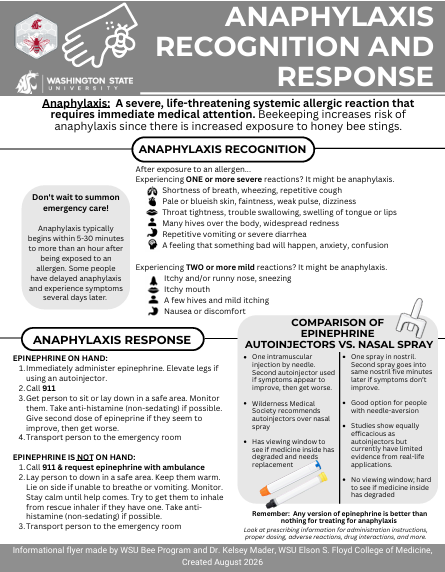
With the FDA approval and official release of the first needle‑free epinephrine delivery system known as neffy® (epinephrine nasal spray), allergic reactions and Anaphylaxis may be top of mind with you and your fellow beekeepers. WSU College of Medicine has put together the below informational flyer to further bring awareness of this risk. You can find more information and resources for neffy® here.
Free Varroa Management Guide
The Honey Bee Health Coalition has released the 9th Edition of the Tools for Varroa Management Guide, a free resource packed with the latest science, best management practices, and treatment options to help beekeepers effectively monitor and control Varroa mites.
In addition to the guide, the Honey Bee Health Coalition offers a variety of educational resources, including videos, best practice recommendations, and other tools to support healthy colonies. Visit their website to download the guide and explore their complete library of beekeeping resources.
WSU Survey
The Washington State University Bee Program, Department of Entomology is seeking Washington beekeepers to participate in a three-year research project focused on Varroa mite management. Researchers hope to enroll at least 100 beekeepers by November 2026.
Participants will complete an initial survey about their beekeeping experience, colony losses, Varroa management practices, and the resources they rely on for education. Follow-up surveys will be conducted in 2027 and 2028 to better understand how management strategies evolve over time. Participants will also be invited to watch HIVE PNW (Holistic Integrated Varroa Education for the Pacific Northwest), a free 10-part educational video series launching in December 2026.
If you're interested in contributing to research that will help improve honeybee health across Washington, visit the project website to learn more, provide consent, and receive your unique participant identification code before completing the surveys.
Other Resources
Beekeeping for Veterans - https://wafarmvetco.org/healing-through-hives
Resource List for Diagnostic Testing of Honey Bees
If you want an answer on the cause of death of your bees, the following is a list of organizations in the United States that may be able to assist you. For a complete list of diagnostic labs and what they will test, go to this website: https://apiaryinspectors.org/page-18060.
If you believe the apiary was damaged though the use of pesticides and if you have registered your hive(s) with the State Department of Agriculture, you can also contact Katie Buckley (Pollinator Health Coordinator) with the WA Department of Agriculture and report the situation as a potential bee kill: kbuckley@agr.wa.gov. They usually only formally investigate if it is a large number of hives that were killed.
WSU Bee Program recommends people send their bees to the Beltsville Bee Lab, a free source in Maryland. This facility tests for bacterial, fungal and microsporidian diseases, two species of parasitic mites, and other honey bee pests. They also test for American foul brood when requested. This lab does not test for viruses or pesticides.
The following all charge for their testing services.
Virus Testing (not pesticides)
-
North Carolina State - fees range from $24-$320
-
National Agricultural Genotyping Center - fees range from $60-$300
Pesticide Testing (not viruses)
-
Synergistic Pesticide Laboratory - this is a lab WSU's bee program has used. Direct contact is Camille Holladay (cholladay@synpestlab.com). Fees range from $165-$365.


Leadership Team 2026
Permits and Compliance Chair
Stephen Poore